CASEO-LASER-DHS · Slab Laser Technology
High Repetition Rate
Short Pulse Slab Laser
Diode-pumped solid-state Innoslab laser delivering M² < 1.3 beam quality, < 10 ns pulse width, 1–10 kHz adjustable repetition rate, and up to 60 mJ pulse energy. Built for scientific research and industrial precision machining.
Choose us — internationally advanced performance at a lower price.
CASEO-LASER-DHS
High repetition rate short pulse Innoslab slab laser — exceptional thermal stability and long-term operational consistency with near-diffraction-limited beam quality.
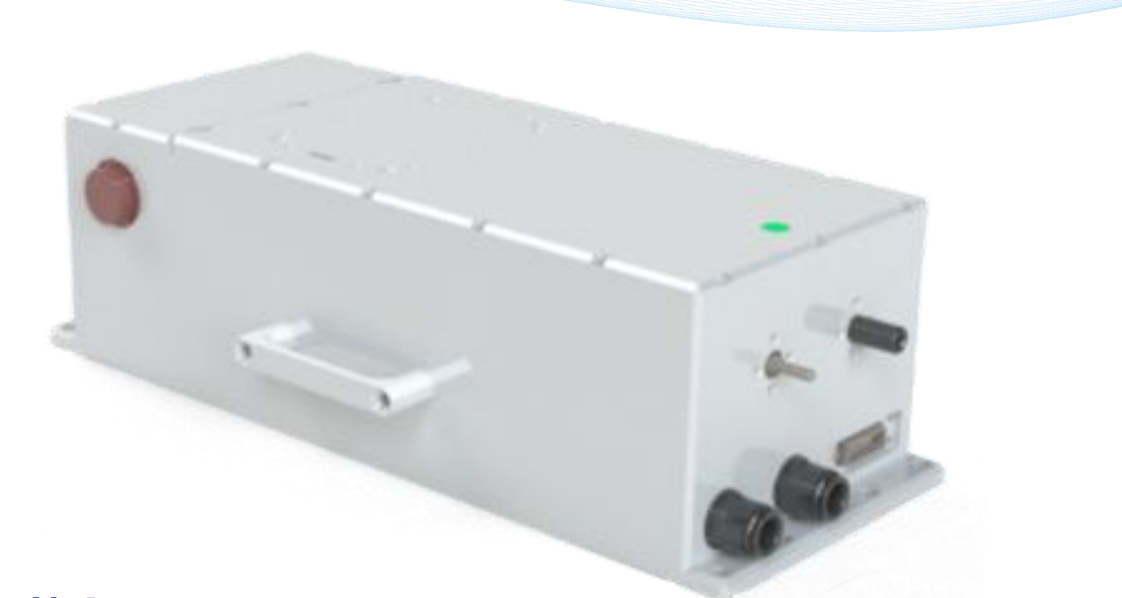 Diode-Pumped Solid-State (DPSS)
DHS Series
Electro-optically Q-switched slab (Innoslab-type) laser · Wavelengths 1064 / 532 / 355 nm
Optical Performance
Beam Characteristics
Physical & Power
- ✓ Maintenance-free operation — no routine optics cleaning required
- ✓ Compact, robust design for easy system integration
- ✓ Long operational lifetime with high reliability
- ✓ Multi-wavelength support with customized configurations available
Why CASEO-LASER-DHS
High Beam Quality (M² < 1.3)
Near-diffraction-limited beam enables micron-scale precision in spectroscopy, imaging, and materials processing applications.
Short Pulse Width (< 10 ns)
Nanosecond-class pulses with high peak power minimize thermal damage — ideal for LIBS, ablation studies, and precision machining of brittle materials.
Adjustable Repetition Rate (1–10 kHz)
Wide tunable range from single-shot to 10 kHz allows optimization for diverse applications — from time-resolved spectroscopy to high-throughput processing.
High Pulse Energy (60 mJ)
Exceptional pulse energy for efficient pumping of Ti:Sapphire amplifiers, OPO/OPA systems, and dye lasers. Strong signal generation in LIBS and LIF.
Customizable Beam Profile
Output line-shaped or circular beams on demand — no external beam shaping optics required. Tailor the spatial profile to your specific experiment or process.
High Reliability, Long Lifetime
Robust diode-pumped solid-state design with conduction-cooled pump diodes. Proven long-term consistency in demanding laboratory and industrial environments.
Compact & Maintenance-Free
Integrated design with minimal footprint. No routine optics alignment or cleaning required — focus on your research, not your laser.
Scientific Research & Precision Industry
From laser-induced breakdown spectroscopy to precision machining of hard and brittle materials — the DHS series serves demanding applications across research and industry.
LIBS
Laser-Induced Breakdown Spectroscopy — elemental analysis with high peak power pulses for strong plasma generation and sensitive detection.
LIDAR
Laser detection and ranging — atmospheric sensing, remote monitoring, and 3D mapping with high pulse energy and adjustable repetition rate.
PIV
Particle Image Velocimetry — flow field visualization in fluid dynamics research. Short pulses freeze particle motion for high-resolution velocity mapping.
LIF
Laser-Induced Fluorescence — molecular and biological imaging. High beam quality for precise excitation and sensitive fluorescence detection.
Ti:Sapphire / Dye Laser Pumping
60 mJ pulse energy at 532 nm for efficient pumping of tunable laser systems. Ideal pump source for ultrafast amplifier chains.
OPO / OPA Pumping
Optical parametric oscillator and amplifier pumping — wavelength-tunable source generation for spectroscopy and quantum optics research.
Precision Machining
Hard and brittle material processing — ceramics, glass, sapphire. Short pulses with high peak power for clean ablation and micro-structuring.
Your Application
Custom configurations available — see customization options or contact us to discuss your specific wavelength, energy, or beam profile requirements.
Configured to Your Application, Not Selected From a Catalog
Every DHS system is built to order. Wavelength, pulse energy, repetition rate, beam profile, control interfaces, and mechanical envelope are specified around your application — from standard laboratory installations to fully integrated OEM subsystems.
Wavelength & Harmonics
Fundamental 1064 nm with internal or external SHG (532 nm), THG (355 nm) and FHG (266 nm). Alternative fundamentals and OPO-pumped tunable output available on request.
Pulse Energy & Repetition Rate
30 mJ or 60 mJ platforms, single-shot to 10 kHz. Burst-mode and pulse-on-demand triggering for synchronized, camera-gated experiments.
Beam Profile & Spot Geometry
Line or circular output, custom spot diameters, flat-top or near-Gaussian profiles, and polarization control up to 100:1 — no external beam-shaping optics required.
Pulse Width & Timing
Sub-10 ns standard, with Q-switch timing tailored to your ablation or detection window. External trigger input with programmable delay.
Control & Integration
TTL triggering, RS-232 / Ethernet control, and burst gating. SDK with LabVIEW and Python drivers for automated measurement setups.
Mechanical & Cooling Options
Integrated or remote chiller, head-only OEM configurations, custom mounting interfaces, and cable lengths matched to your system layout.
Environmental Hardening
Extended temperature and humidity ranges, dust and vibration tolerance, and altitude derating for field-deployed LIDAR and outdoor installations.
Compliance & Certification
CE and FDA documentation, laser-safety interlock integration, and Class IV enclosure design support for your system-level certification.
Typical configurations by application
Starting points based on common research and industrial requirements — every parameter remains adjustable.
| Application | Typical configuration | Why it works |
|---|---|---|
| LIBS | 1064 or 532 nm · 1–10 kHz · line beam · <2% RMS stability | High peak power ablates cleanly for strong, reproducible plasma emission; kHz rates accelerate multi-point mapping and signal averaging |
| LIDAR | 532 nm · high rep rate · <1 mrad divergence · ruggedized head | Narrow divergence extends achievable range; burst triggering synchronizes with fast scanners and gated detectors |
| PIV / LIF | 532 or 355 nm · kHz pulse pairs · flat-top sheet profile | Short pulses freeze particle motion; uniform sheet profiles deliver clean, unsaturated double-frame images |
| Pumping (OPO / OPA / Ti:Sapphire) | 532 nm · 60 mJ · M² < 1.3 | High energy with near-diffraction-limited focus maximizes conversion efficiency and tuning range |
| Precision machining | 355 nm UV · high peak power · industrial duty cycle | UV absorption and short pulses minimize the heat-affected zone in hard, brittle materials |
How customization works
- 1Requirements review
Application, target parameters, and integration constraints
- 2Optical & system design
Our engineers propose a configuration against your specification
- 3Proposal & quotation
Firm specifications, lead time, and pricing
- 4Build & validation
Factory acceptance testing against agreed parameters
- 5Delivery & support
Installation guidance, documentation, application engineering
DHS Series — Complete Parameter List
All values measured at 1064 nm fundamental wavelength unless otherwise noted. Custom configurations available upon request.
| Parameter | Specification |
|---|---|
| Wavelength | 1064 nm, 532 nm, 355 nm (customizable) |
| Beam Quality (M²) | < 1.3 |
| Repetition Rate | 1 – 10 kHz (adjustable) |
| Max Single Pulse Energy | 60 mJ or 30 mJ (customizable) |
| Pulse Width | < 10 ns |
| Energy Stability (RMS) | 2% |
| Beam Divergence | < 1 mrad |
| Spot Size (Diameter) | 3 mm |
| Spot Shape | Line / Circular (customizable) |
| Polarization Extinction Ratio | 100 : 1 |
| Warm-up Time (Cold Start) | 15 min |
| Power Supply Voltage / Input Power | Single-phase 220 V ±10%, 50/60 Hz AC / 1 kW |
| Chiller Voltage / Input Power | Single-phase 220 V ±10%, 50/60 Hz AC / 1.4 kW |
| Cooling Method | Water-cooled |
| Operating Temperature | 15 °C – 30 °C |
| Operating Humidity | 10% Rh – 60% Rh |
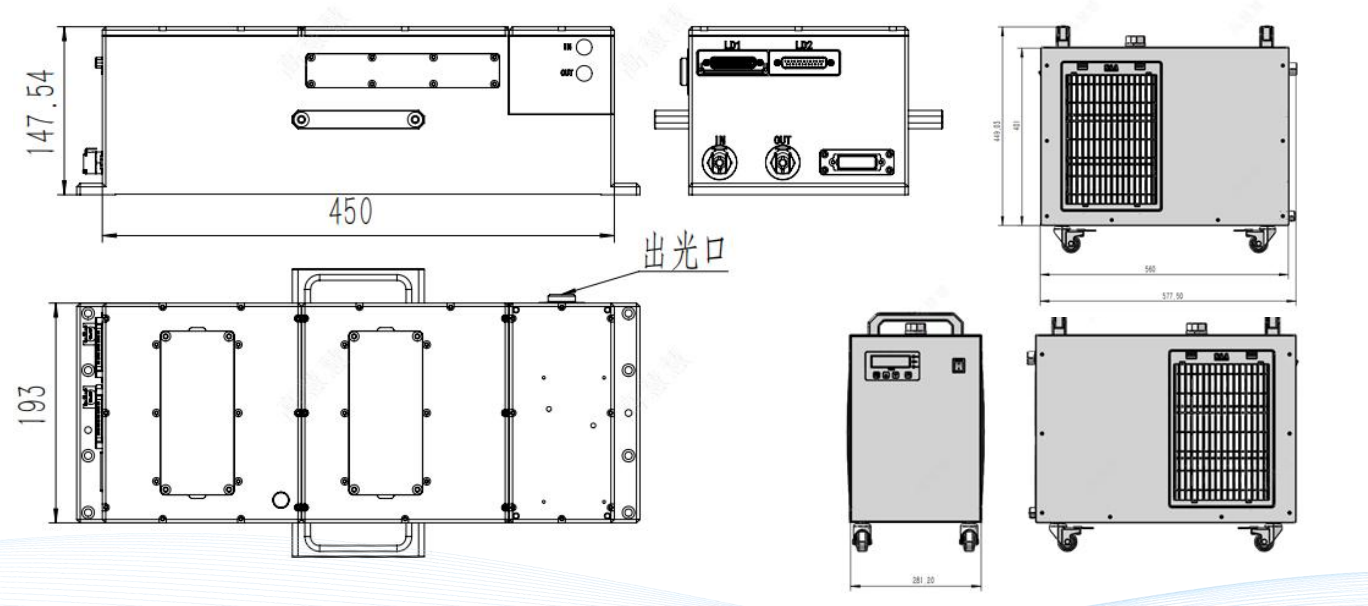
| Laser Head Dimensions (L × W × H) | 495 mm × 193 mm × 151 mm |
| Chiller Dimensions (L × W × H) | 450 mm × 578 mm × 281 mm |
| Laser Head Weight | 30 kg |
| Chiller Weight | 30 kg |
| Laser Type | Diode-Pumped Solid-State (DPSS) · Electro-Optic Q-Switched · Innoslab |
| Gain Medium | Nd:YAG |
Frequently Asked Questions
Technical questions our engineers hear most often from researchers and system integrators.
What is a slab laser, and how does it differ from rod and fiber designs?
A slab laser amplifies in a thin, rectangular gain medium pumped through its large faces. The high surface-to-volume ratio removes heat efficiently, so it sustains high average power at near-diffraction-limited beam quality (M² < 1.3) — while keeping the high pulse energy and wavelength flexibility that fiber designs trade away. When an application needs beam quality and pulse energy together, the slab geometry is usually the right starting point.
Which applications is the CASEO-LASER-DHS series designed for?
High-repetition-rate, short-pulse work: LIBS elemental analysis, LIDAR and atmospheric sensing, PIV and LIF diagnostics, pumping of Ti:Sapphire, dye, OPO and OPA systems, and precision machining of hard, brittle materials. Standard wavelengths are 1064, 532 and 355 nm; alternative fundamentals and harmonic combinations are available on request.
Slab laser or fiber laser — how do I choose?
Choose a slab laser when beam quality, pulse energy, and wavelength flexibility dominate — spectroscopy, pumping, imaging, precision ablation. Choose a fiber laser when wall-plug efficiency, compactness, and maintenance-free industrial duty dominate — marking, welding, high-throughput cutting. The DHS series covers the first category with M² < 1.3, up to 60 mJ, and full harmonic coverage.
Can the laser be customized for my specific application?
Yes — every DHS system is built to order. Wavelength, pulse energy, repetition rate, pulse width, beam profile, spot size, polarization, control interfaces, mechanical envelope, and cooling integration are all configurable. See the customization section for the full option list and typical configurations by application.
What are the facility and integration requirements?
Single-phase 220 V ±10% supply (1 kW laser head, 1.4 kW chiller) and water cooling via the supplied chiller. Operating environment is 15–30 °C at 10–60% relative humidity, with a 15-minute warm-up from cold start. Head-only OEM configurations and remote-chiller options are available for system builders.
What documentation and support are provided?
Every system ships with a complete specification sheet and user documentation, installation guidance, and application engineering support. Custom configurations are validated against the agreed parameters before shipment, and our team responds to technical inquiries within 24 hours on business days.
Request a Quote or Technical Consultation
Our engineering team in Hangzhou, China responds within 24 hours. Global shipping available.
Contact CAS-EO
Reach us directly for technical specifications, pricing, lead times, or custom configuration requests.